Foundations and limits
Understand what spectral information can be computed, what is impossible, and which additional assumptions make a problem tractable.
Cambridge University Press · 2026
Foundations, Algorithms, and Modern Applications
A rigorous and practical guide to computing spectral properties of infinite-dimensional operators, from fundamental limits to modern data-driven applications.
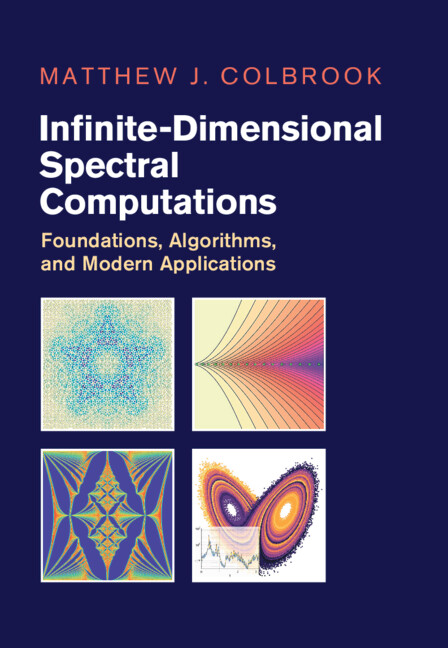
About the book
Computing spectral properties in infinite dimensions is deceptively difficult. Standard discretisations can produce misleading answers, while natural finite-dimensional approximations may miss essential features of the underlying operator.
The book develops a unified framework for understanding these obstacles and overcoming them. It combines precise computability classifications with implementable algorithms, certified error bounds, worked examples, exercises, and modern applications.
Understand what spectral information can be computed, what is impossible, and which additional assumptions make a problem tractable.
Develop resolvent-based methods with provable convergence, rigorous error control, and a clear route from analysis to verified computation.
Explore pseudospectra, spectral measures, fractal spectra, nonlinear operator pencils, and a rigorous treatment of data-driven Koopman spectral analysis.
Companion materials
The companion materials are intended to make the theory usable: implementations for experimentation and complete solutions for working through the exercises.
Implementations and examples accompanying the algorithms developed in the book.
Open GitHub repositoryComplete solutions for the exercises, provided as a freely available PDF.
Open solutionsEndorsements
Perspectives from leaders in spectral theory, numerical analysis, and data-driven dynamics.
Matthew Colbrook has written a brilliant book on a deep subject of central importance. It should be useful to analysts, numerical mathematicians, and mathematically inclined scientists alike. More than that, it should help shape how infinite-dimensional spectral computation is understood in the years ahead.
Nobody has thought about the whole range of spectral analysis like Colbrook -- from the theoretical to the numerical and back again, always with an eye for modern challenges.
Spectral theory is a golden thread running through mathematics and science. This book addresses the fundamental question of how and when we can compute spectra of infinite-dimensional operators with rigorous certainty. Colbrook’s work has been instrumental in advancing this problem, and the book presents a lucid and authoritative account of the subject. The reader is introduced to all the relevant concepts and then led to modern developments in the computability of spectra, with particular attention to the challenges that arise in infinite dimensions. The book is beautifully illustrated with numerical examples, and the set of interesting exercises will be helpful to anyone wishing to gain a solid grasp of the subject. This is a striking synthesis of pure mathematics and computational science.
‘What is computationally possible in spectral theory?’ In this enlightening book, you will find the comprehensive answer to this question. Alongside a wealth of applications and exercises, it combines meticulous numerical analysis with an engaging narrative. This is a landmark contribution to the computation of spectra in infinite dimensions.
With an incredible breadth and balance of material, this book is a must-read for anyone seeking to harness the power of spectral theory for modern applications. It establishes a rigorous and practical foundation for spectral techniques, including Koopman operator methods, that now underpin advances across engineering, physics, and machine learning.