About Me
I am a Henslow Research Fellow at Clare Hall, University of Cambridge, based in the Applied, Computational and Data Analysis research group at the Department of Applied Mathematics and Theoretical Physics (DAMTP). My research interests cover a range of topics in computational Mathematics, with a particular focus on scientific machine learning and numerical analysis. This includes work on data-driven and structure-preserving methods for differential equations, generative modelling for scientific applications, alongside long-standing interests in highly oscillatory phenomena and computational wave propagation. For more details please see my research page.
In addition, I am also a domain expert and the leader of the working group on Machine Learning for Differential Equations (ML4DE) within Maths4DL. Alongside my academic research, I collaborate regularly with industrial partners on machine learning for scientific and biomedical applications.
Previously, I held a Hooke Research Fellowship in the Numerical Analysis Group at the University of Oxford and a Marie Skłodowska-Curie Fellowship (Project GLIMPSE) at Sorbonne Université in Prof. Katharina Schratz's research group. I completed my PhD as a research scholar of Trinity College, University of Cambridge, under the supervision of Prof. Nigel Peake and Prof. Arieh Iserles.
Employment
Henslow Research Fellow, Clare Hall
Nov 2023 - presentUniversity of Cambridge, UK
Hooke Research Fellow, Mathematical Institute
Mar 2024 - Mar 2025University of Oxford, UK
Marie Skłodowska-Curie Fellow, Laboratoire Jacques-Louis Lions
May 2022 - Oct 2023Sorbonne Université, France
Postdoctoral Researcher, Laboratoire Jacques-Louis Lions
Sep 2021 - April 2022Sorbonne Université, France
Education
University of Cambridge, Trinity College, UK
2017 - 2021PhD student in the Cambridge Centre for Analysis (CCA)
University of Cambridge, Trinity College, UK
2013 - 2017MMath (Part III) & BA (hons) in Mathematics
Honours and Awards
Scientific High Level Visiting Fellowship
September 2025French Embassy in the United Kingdom
Spotlight paper at ICML 2025
July 2025Forty-second International Conference on Machine Learning
IMA Leslie Fox Prize for Numerical Analysis (2nd prize)
Jun 2025The Institute of Mathematics and its Applications, UK
SIAM CS&E Hackathon Challenge Winner
Feb 2023SIAM Conference on Computational Science and Engineering, Netherlands
Junior Research Leader at the Simons Semester 'Around transport and diffusion phenomena'
Dec 2021Institute for Mathematics, Polish Academy of Sciences & Simons Foundation
Scientific machine learning
Differential equations underpin most scientific modelling, and machine learning is starting to change how we solve them. I work on hybrid methods that keep the guarantees of classical numerical analysis while borrowing the flexibility of learned models: graph neural networks that relocate finite element meshes, neural hybrid solvers for implicit time-stepping, and data-driven reduced-order models for large-scale dynamics. I also helped design a common task framework for evaluating scientific ML methods objectively. My latest work focusses on improving data-driven models using structure preservation, approximation theory and numerical analysis broadly.
Numerical methods for dispersive differential equations
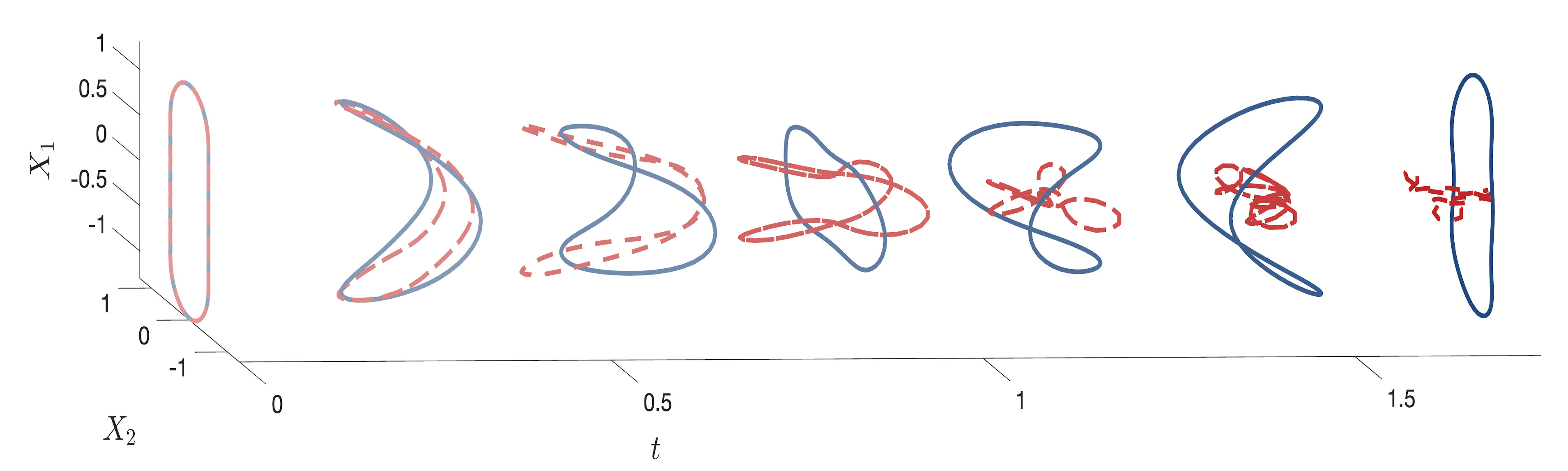
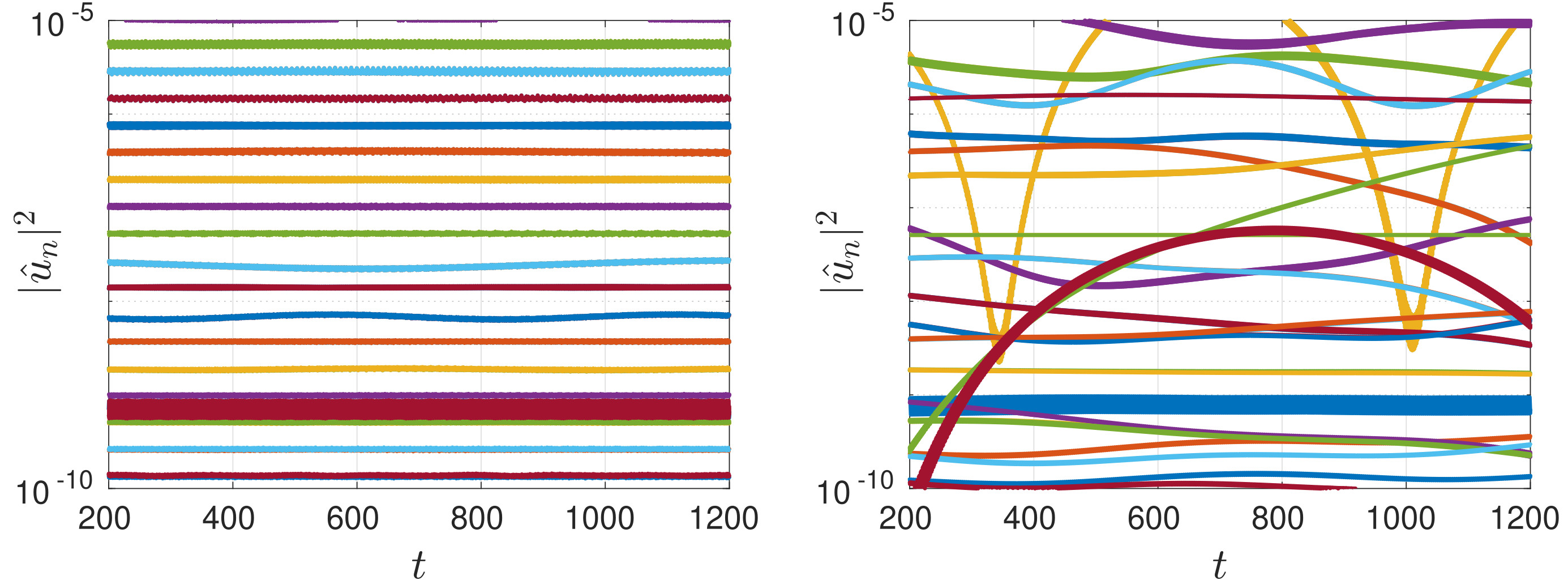
Dispersive equations describe a wide range of phenomena, including water waves, ferromagnetism and relativistic wave propagation in particle physics. In my work I design and analyse reliable and physically meaningful numerical methods. This includes research in geometric numerical integration, low-regularity integration, the use of gauge transforms in numerical schemes, and the analysis of long-time properties of such methods.
Highly oscillatory quadrature and wave scattering
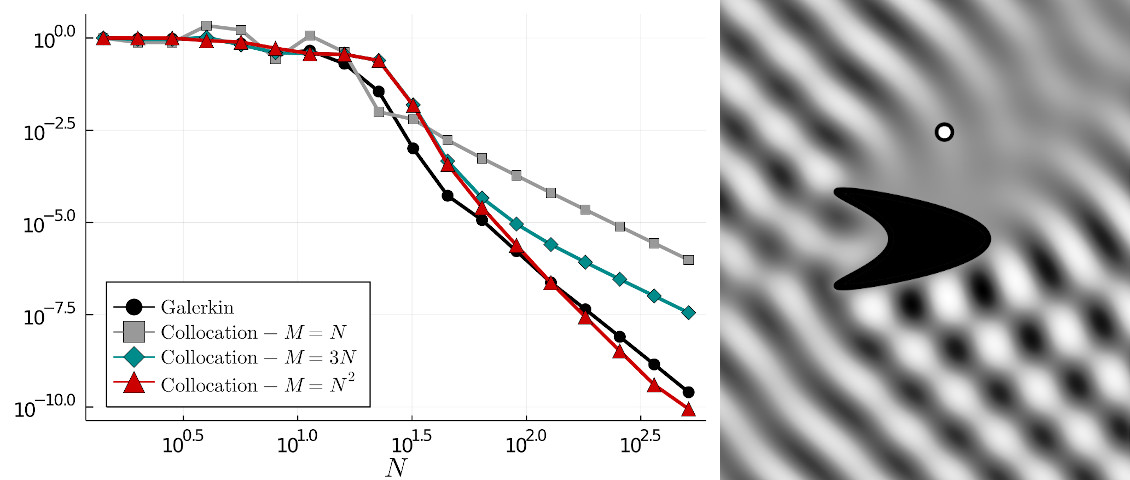
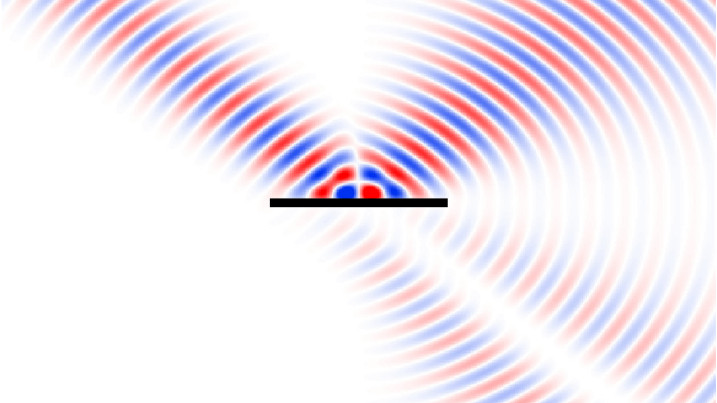
Highly oscillatory problems appear in many physical systems, particularly in the context of wave propagation. Their solution using conventional numerical methods is often prohibitively expensive. My research focusses on incorporating asymptotic knowledge in the design of efficient methods for high-frequency problems. This includes the design of efficient quadrature for hybrid numerical-asymptotic methods and the analysis of regularisation techniques for collocation methods in boundary integral equations.
Machine learning for biomedical applications
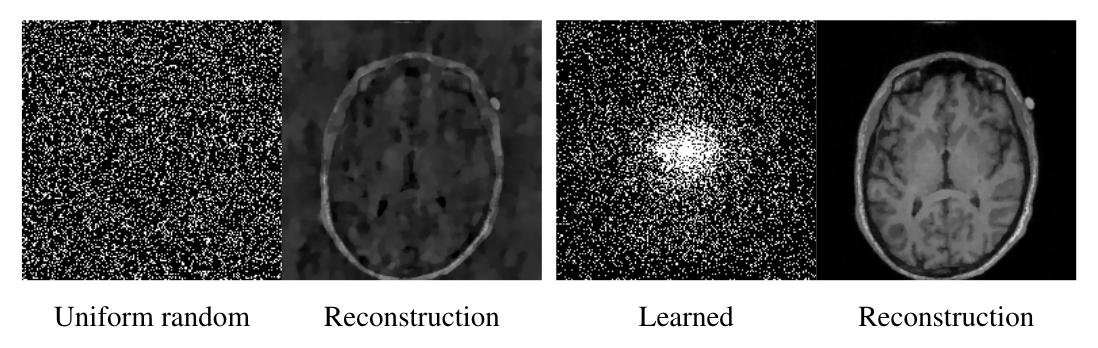
Machine learning has seen increasing success in biomedical applications, from drug design to medical imaging. These methods lead to a host of interesting mathematical questions often connected to the study of (stochastic) differential equations and numerical methods. My work in this area covers generative models for medical data and drug design as well as applications in imaging.
Scientific machine learning
Physics-informed reduced-order modelling with equivariant spectral submanifolds.
Maierhofer, G.
Under review.
Download: preprint
CTF4Nuclear: Common Task Framework for Nuclear Fission and Fusion Models.
Riva, S., Introini, C., Cammi, A., Price, D., Yermakov, A., Zhao, Y., Wyder, P. M., Goldfeder, J., Williams, J., Rude, A. S., Tomasetto, M., Germany, J., Bakarji, J., Maierhofer, G., Cranmer, M., Kutz, J. N.
Under review.
Download: preprint
The Seismic Wavefield Common Task Framework. ICLR 2026
Yermakov, A., Zhao, Y., Denolle, M., Ni, Y., Wyder, P. M., Goldfeder, J., Riva, S., Williams, J., Zoro, D., Rude, A. S., Tomasetto, M., Germany, J., Bakarji, J., Maierhofer, G., Cranmer, M., Kutz, J. N.
International Conference on Learning Representations (2026).
Download: published version | preprint
Common Task Framework for a Critical Evaluation of Scientific Machine Learning Algorithms. NeurIPS 2025
Wyder, P., Goldfeder, J., Yermakov, A., Zhao, Y., Riva, S., Williams, J., Zoro, D., Rude, A., Tomasetto, M., Germany, J., Bakarji, J., Maierhofer, G., Cranmer, M., Kutz, J. N.
Proceedings of the Thirty-Ninth Conference on Neural Information Processing Systems.
Download: published version | preprint
G-Adaptivity: optimised graph-based mesh relocation for finite element methods. ICML 2025 spotlightSTEM for Britain finalist 2026
Rowbottom, J.*, Maierhofer, G.*, Deveney, T., Mueller, E., Paganini, A., Schratz, K., Liò, P., Schönlieb, C.-B., Budd, C. *joint first authors
Proceedings of the Forty-second International Conference on Machine Learning (2025).
Download: published version | preprint
A fast neural hybrid Newton solver adapted to implicit methods for nonlinear dynamics.
Jin, T., Maierhofer, G., Schratz, K., Xiang, Y.
Journal of Computational Physics (2025).
Download: published version | preprint
Numerical methods for dispersive differential equations
Stable Hermite transforms via the Golub-Welsch algorithm.
Webb, M., Maierhofer, G.
Under review.
Download: preprint
Computing nonlinear Schrödinger equations with Hermite functions beyond harmonic traps.
Banica, V., Maierhofer, G., Schratz, K.
Under review.
Download: preprint
A Wong-Zakai resonance-based integrator for nonlinear Schrödinger equation with white noise dispersion.
Cui, J., Maierhofer, G.
Under review.
Download: preprint
On scattering for NLS: rigidity properties and numerical simulations via the lens transform.
Carles, R., Maierhofer, G.
Mathematical Models and Methods in Applied Sciences (2026).
Download: published version | preprint
Fully discrete backward error analysis for the midpoint rule applied to the nonlinear Schrödinger equation.
Faou, E., Maierhofer, G., Schratz, K.
Numerische Mathematik (2026).
Download: published version | preprint
Symmetric resonance based integrators and forest formulae.
Alama Bronsard, Y., Bruned, Y., Maierhofer, G., Schratz, K.
Foundations of Computational Mathematics (2025).
Download: published version | preprint
Explicit symmetric low-regularity integrators for the nonlinear Schrödinger equation.
Feng, Y., Maierhofer, G., Wang, C.
SIAM Journal on Scientific Computing (2025).
Download: published version | preprint
Bridging the gap: symplecticity and low regularity in Runge-Kutta resonance-based schemes. Leslie Fox Prize
Maierhofer, G., Schratz, K.
Mathematics of Computation (2025).
Download: published version | preprint
Long-time error bounds of low-regularity integrators for nonlinear Schrödinger equations.
Feng, Y., Maierhofer, G., Schratz, K.
Mathematics of Computation (2024).
Download: published version | preprint
Numerical integration of Schrödinger maps via the Hasimoto transform.
Banica, V., Maierhofer, G., Schratz, K.
SIAM Journal on Numerical Analysis (2024).
Download: published version | preprint
Highly oscillatory quadrature and wave scattering
An accelerated Levin–Clenshaw–Curtis method for the evaluation of highly oscillatory integrals.
Iserles, A., Maierhofer, G.
BIT Numerical Mathematics (2025).
Download: published version | preprint
Recursive moment computation in Filon methods and application to high-frequency wave scattering in two dimensions.
Maierhofer, G., Iserles, A., Peake, N.
IMA Journal of Numerical Analysis (2024).
Download: published version | preprint
An analysis of least-squares oversampled collocation methods for compactly perturbed boundary integral equations in two dimensions.
Maierhofer, G., Huybrechs, D.
Journal of Computational and Applied Mathematics (2022).
Download: published version | preprint
Convergence analysis of oversampled collocation boundary element methods in 2D.
Maierhofer, G., Huybrechs, D.
Advances in Computational Mathematics (2022).
Download: published version | preprint
Acoustic and hydrodynamic power of wave scattering by an infinite cascade of plates in mean flow.
Maierhofer, G., Peake, N.
Journal of Sound and Vibration (2021).
Download: published version | preprint
Wave scattering by an infinite cascade of non-overlapping blades.
Maierhofer, G., Peake, N.
Journal of Sound and Vibration (2020).
Download: published version | preprint
Machine learning for biomedical applications
Privacy-preserving Generative Modeling and Clinical Validation of Longitudinal Health Records for Chronic Disease.
Ballyk, B., Gupta, A., Konda, S., Subramanian, K., Landon, C., Naseer, A., Maierhofer, G., Swaminathan, S., Venkateshwaran, V.
Proceedings of the 2025 Machine Learning for Health Conference (ML4H).
Download: published version | preprint
Learning the Sampling Pattern for MRI.
Sherry, F., Benning, M., De los Reyes, J. C., Graves, M. J., Maierhofer, G., Williams, G., Schönlieb, C.-B., Ehrhardt, M.
IEEE Transactions on Medical Imaging (2020).
Download: published version | preprint
Mirror, Mirror, on the Wall, Who’s Got the Clearest Image of Them All? — A Tailored Approach to Single Image Reflection Removal.
Heydecker, D., Maierhofer, G., Aviles-Rivero, A. I., Fan, Q., Chen, D., Schönlieb, C.-B., Süsstrunk, S.
IEEE Transactions on Image Processing (2019).
Download: published version | preprint
Peekaboo — Where are the Objects? Structure Adjusting Superpixels.
Maierhofer, G., Heydecker, D., Aviles-Rivero, A. I., Alsaleh, S. M., Schönlieb, C.-B.
25th IEEE International Conference on Image Processing (2018).
Download: published version | preprint
Earlier work
An extension of standard Latent Dirichlet Allocation to multiple corpora.
Foster, A., Li, H., Maierhofer, G., Shearer, M.
SIAM Undergraduate Research Online, Volume 9 (2016).
Download: published version
Geometric Measure of Arens Irregularity.
Hernandez Palomares, R., Hu, E., Maierhofer, G. A., Rao, P.
Fields Institute for Research in Mathematical Sciences (2015).
Download: published version
Code
Software from my research, most of it open source. For a demonstration, or for suggestions and collaboration, please get in touch.
CTF4Science
A common task framework for scientific machine learning: fixed datasets, held-out evaluation and automated scoring, so competing methods for dynamical systems can be compared on equal terms rather than on self-reported numbers.
With J. N. Kutz and the CTF for Science team. Paper.
G-Adaptivity
Graph neural networks that efficiently reduce finite element error by optimally relocating mesh points.
Joint lead author and developer.
With J. Rowbottom, T. Deveney, E. Müller, A. Paganini, K. Schratz, P. Liò, C.-B. Schönlieb and C. Budd. Paper. An easier starting point, with pretrained models and demo notebooks, is MeshStudioAI.
eSSM
Equivariant spectral submanifold reduction: data-driven nonlinear model order reduction that builds the symmetries of the full-order model into the reduced one, giving faster fits and more robust reduced dynamics.
Accompanies the preprint Physics-informed reduced-order modelling with equivariant spectral submanifolds.
GLIMPSE
Toolbox with a wide range of numerical methods (classical, structure-preserving, and low regularity) for dispersive nonlinear equations.
From my Marie Skłodowska-Curie fellowship GLIMPSE. Related papers.
IntegralEquations2D.jl
Toolbox for boundary integral equations in two-dimensional wave scattering problems, including functionality for oversampled collocation methods.
With D. Huybrechs. Related papers.
Current students
- Jiya DhootUndergraduate research intern, 2026Parametric generalisation of Koopman operators
- Matthew GillowUndergraduate research intern, 2026Parametric generalisation of Koopman operators
- Jonathan KellyMaster's dissertation, 2025/26Principled approaches to score matching in diffusion models
Past students
- Moonis HaiderMaster's dissertation, 2025/26
- Theeran RamananMaster's dissertation, 2025/26
- Penelope ForcioliMaster's dissertation, 2024/25now MSc, Paris Dauphine
- Moritz HauschulzMaster's dissertation, 2024/25now PhD, University of Oxford
- Ade OlugbojiMaster's dissertation, 2024/25now Citadel
- Johan SlettengrenMaster's dissertation, 2024/25now MSc, KTH
- Emre UlusoyMaster's dissertation, 2024/25now PhD, Imperial College London
- Zihan ZhouMaster's dissertation, 2024/25
- Benjamin BallykMaster's dissertation, 2024now PhD, University of Oxford
- Qinyan ZhouMaster's dissertation, 2023now PhD, ENSTA
Selected industrial collaborations
Alongside my academic research I regularly work with industry on projects and events related to machine learning for scientific and biomedical applications.
-
InstaDeep Ltd2026 - present Research collaboration on generative models for biomedical applications.
-
National Air Traffic Services (NATS)2026 Lead organiser of a joint industrial hackathon on optimal control and scientific machine learning.
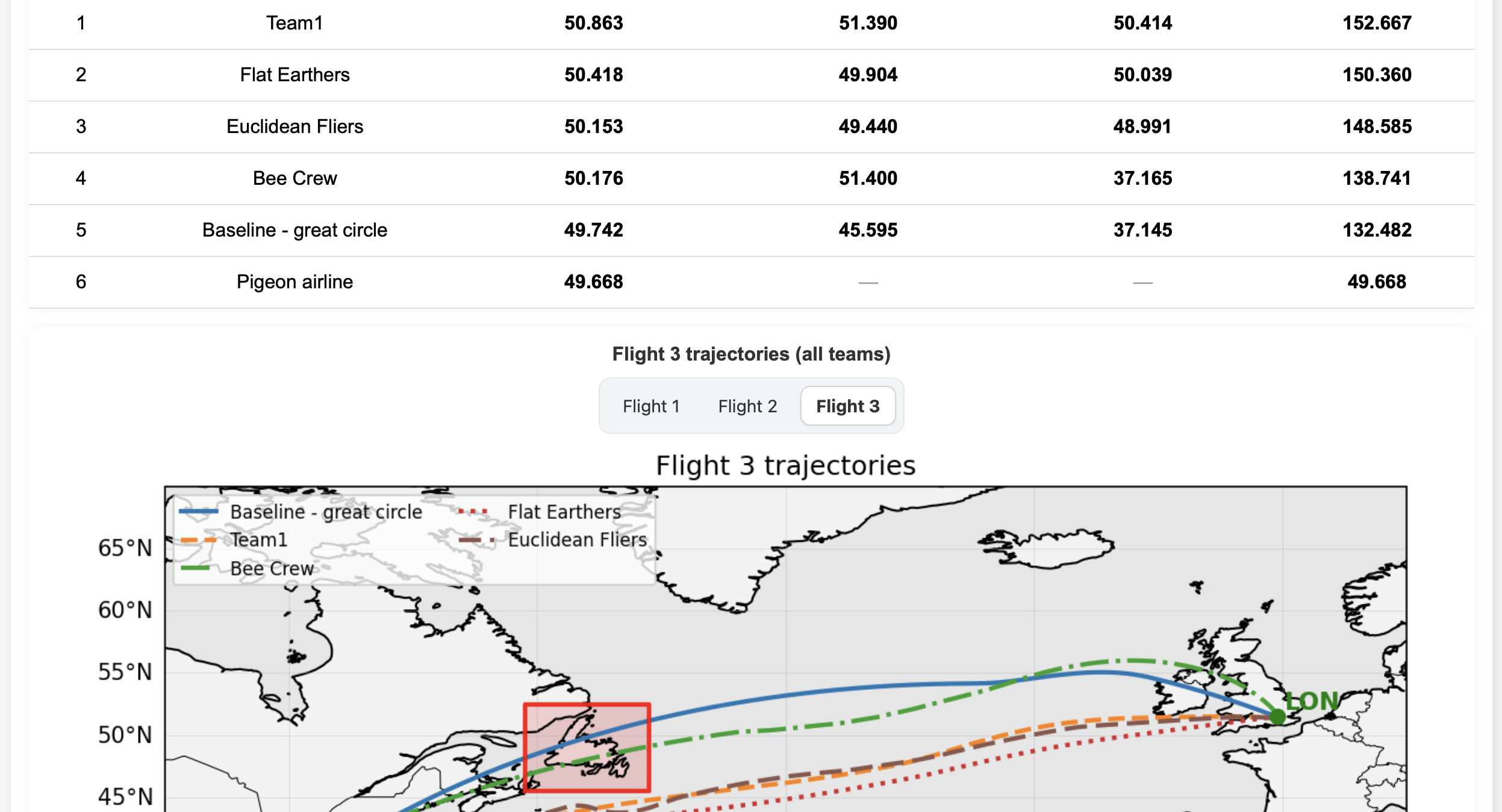
Optimised flight trajectories over the Atlantic (more details) -
Vironix Health, Inc.2024 Joint supervision of an industrial MSc project on privacy-preserving generative modelling of longitudinal health records, published at ML4H 2025.
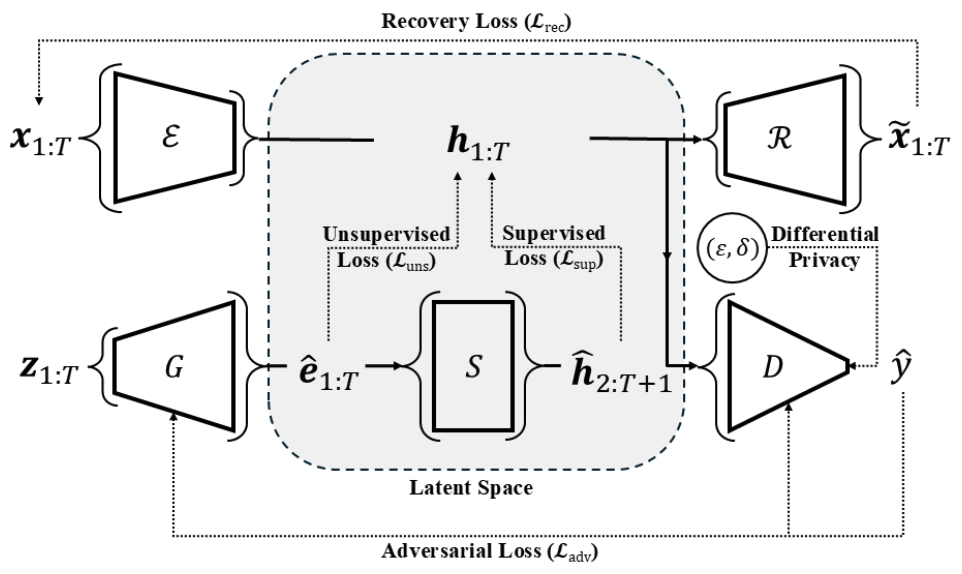
DP-TimeGAN architecture (more details)
If you are interested in working together on a scientific machine learning problem in your organisation, I would be glad to hear from you.
Research talks
Below is a list of some of my recent invited presentations, some with recording. If you saw one of my presentations and would like a copy of my slides please feel free to contact me.
Selected invited talks
Hybrid methods for efficient and reliable Scientific Machine Learning
September 2026 | UpcomingBiennial Prob_AI Hub workshop, Manchester, UK
Runge-Kutta resonance-based schemes for dispersive nonlinear equations
July 2026Invited minisymposium, Foundations of Computational Mathematics (FoCM) 2026, Vienna, Austria
Modern Algorithms for Complex Systems: Bridging Principled Scientific Computing and Data-Driven Methods
May 2026Invited talk at InstaDeep Ltd, London, UK
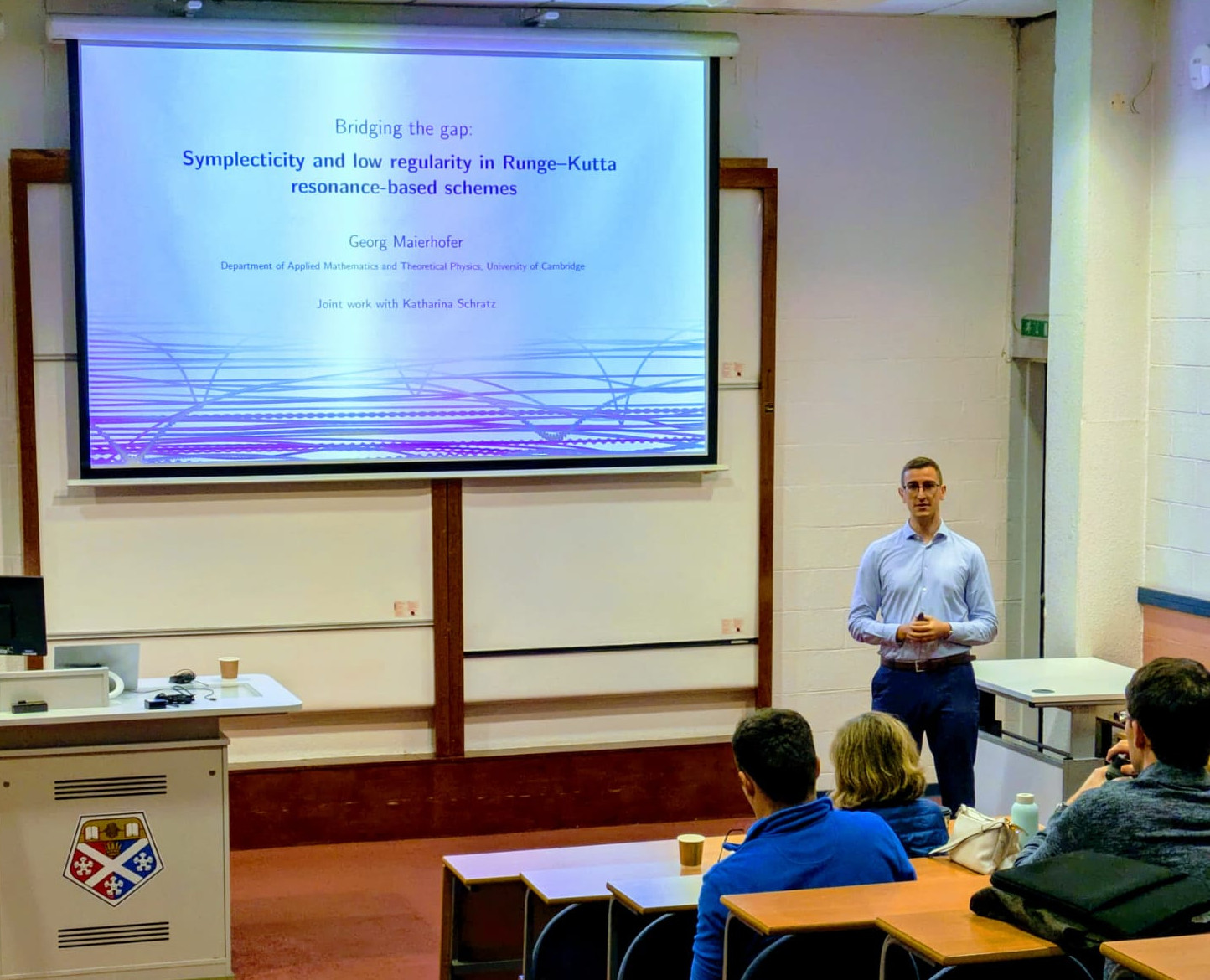
Bridging the gap: symplecticity and low regularity in Runge-Kutta resonance-based schemes
June 2025 | Picture belowLeslie Fox Prize talk, Institute of Mathematics and its Applications, UK
Challenges and opportunities of machine learning for differential equations
June 2025Applied Mathematics Seminar, University of Warwick, UK
Structure-preserving low-regularity integrators for dispersive nonlinear equations
April 2024 | Link to recordingModern Methods for Differential Equations of Quantum Mechanics, BIRS, Canada
Analysis of oversampled collocation methods for wave scattering problems
February 2023Canonical scattering problems workshop, Isaac Newton Institute, UK
Structure preserving low-regularity integrators for the Korteweg–De Vries and the nonlinear Schrödinger equations
July 202230th Birthday of Acta Numerica, Będlewo, Poland
Outreach
I have had the privilege of being involved with several activities that sought to share the potential and the beauty of Mathematics with a wider audience, both within and outside of academia. Below are a few examples of those activities, which summarise also some of my main research interests for enthusiasts from other fields.
Selected activities
Brainstorming AI with Maths4DL
June 2025 | Link to podcastThe Maths Plus Magazine visited a recent hackathon organised in the framework of the Maths4DL working group on Machine Learning for Differential Equations and this podcast discusses the remits of such events in driving innovation in scientific machine learning.
AI goes to physics class
December 2024 | Link to articleFurther to the below podcast the Maths Plus magazine wrote an article on the use of physics based information to improve machine learning tools for scientific computing.
How physics can help AI learn about the real world
April 2024 | Link to podcastIn my collaboration with the Maths4DL working group on Machine Learning for Differential Equations I was invited to join a podcast by the Maths Plus magazine discussing recent advances in machine learning for scientific computing.
Resonance-based schemes for low-regularity simulations of dispersive equations and beyond
July 2023 | Link to articleAs part of the ERC grant LAHACODE and my MSCA fellowship project GLIMPSE, Prof. Katharina Schratz and I wrote a brief article describing modern numerical methods for dispersive equations for the European Community on Computational Methods in Applied Sciences newsletter.
How Mathematics can help you sleep at night... - Overview of research in the Mathematical Analysis in Acoustics SIG
December 2021 | Link to slidesThis presentation contains an overview of ongoing mathematical research in the area of acoustics and was given in my role as Early Career Representative in the Special Interest Group for Mathematical Analysis in Acoustics within UKAN+.
The inspiring versatility of Mathematics and PhD studies at the University of Cambridge
March 2021 | Link to MINT TANK-Story (in German)An interview by the Kaiserschild-Stiftung discussing the joy of working as a Mathematician, and the wide range of applications of modern Mathematics.